
A handmade rug is built from thousands of individually tied knots, and the difference from machine-made is visible the moment you flip it over. The catch is that stores rarely volunteer this view, and most buyers never think to ask. On the back of a genuine piece, the knots read like handwriting: slightly uneven, never identical, with the pattern showing through almost as clearly as on the face. That irregularity is the proof you are looking for.
1. Flip the Rug Over First

The back of a rug is where the lie falls apart. Flip one over in a store and the difference between hand-tied and machine-stitched shows up in about three seconds.
A handmade rug carries thousands of slightly uneven knots on its underside. Each one was tied by hand around the warp threads, so no two sit at exactly the same angle or tension. The pattern bleeds through clearly, almost like you’re looking at it through a screen. The foundation stays flexible; it bends and drapes rather than holding a rigid rectangle.
Machine-made rugs give themselves away with a backing that looks too perfect. The underside shows a uniform grid, sometimes with a stiff glued layer or overstitch construction holding the pile in place. Individual knots don’t exist. The pattern may look blurry or printed rather than woven through. If the back resembles a honeycomb stamped out by a loom, that’s exactly what happened.
Some irregularities on a handmade back are normal. Slight variations in knot size, a row that wobbles by a hair, small color shifts from one dye batch to the next: these are signs of human work, not flaws. The rug I keep by my bed has a spot near one corner where two knots overlap slightly. I noticed it the day I brought it home, and now I check for that same tell when I’m hunting in secondhand shops.
Recommended Products

Designer Aesthetic: The stylish pieces from the Loren collection blend traditional, vintage, and modern design that exudes elegance.The collection infuses distressed boho textures with modern materials and colors for a Moroccan inspired style.

95% Jute, 5% Wool, made in India

Luxurious Craftsmanship: Expertly hand-knotted by skilled artisans, each Luxe Loom rug epitomizes timeless elegance and quality craftsmanship
2. Check Where the Fringe Starts

The fringe on a hand-knotted rug is the warp threads extending from the loom, not a separate piece stitched on after the fact. Flip the rug over and look where the fringe meets the body: in a genuine piece, the threads continue uninterrupted into the pile, while machine-made rugs show a fabric or mesh strip with visible glue or stitching along that edge.
Synthetic fringe added later tends to look too uniform, with each strand the same length and thickness. Natural cotton or wool fringe on handmade rugs varies slightly, and a gentle tug won’t detach it because the entire rug structure depends on those threads. If the fringe comes away or you can see where it was sewn on, the rug was produced by machine.
Recommended Products

PATTERN: This handmade jute rug half-moon chindi jute with chevron-style weaving, crafted from natural jute in earthy tones, framed by a simple border for a rustic yet modern…
3. Read the Knots Like Handwriting

Turn the rug over and the back tells the story. On a hand-knotted piece, the knots read like handwriting: slightly different sizes, spacing that drifts a little, the occasional knot sitting a hair higher or lower than its neighbor. You can make out the individual ties, and through them the pattern and colors come through almost as clearly as on the face. That unevenness is the mark of a person working row by row, knot by knot.
A machine-made rug shows the opposite. The back looks like a grid: perfectly even rows, identical spacing, no visible pile pushing through. What you see instead is a smooth overstitch or a printed, sometimes glued, backing holding everything together. The knots, if they exist at all, are uniform to the point of looking mechanical.
I used to think perfection meant quality. The first time I flipped a rug and saw those irregular knots, I assumed something had gone wrong in the making. Now I know better: perfect symmetry on the back is the red flag. The slight wobble in a hand-tied knot is what you want. It means a weaver sat at a loom and worked the design by eye and feel, not that a computer ran a pattern through a power loom and checked every row for deviation.
Recommended Products

PREMIUM 100% WOOL CONSTRUCTION: Made entirely from 100% wool, this hand-tufted area rug delivers a naturally soft feel with a dense, textured surface built for regular indoor use.
PREMIUM 100% WOOL CONSTRUCTION: Made entirely from 100% wool, this hand-tufted area rug delivers a naturally soft feel with a dense, textured surface built for regular indoor use.
PREMIUM 100% WOOL CONSTRUCTION: Made entirely from 100% wool, this hand-tufted area rug delivers a naturally soft feel with a dense, textured surface built for regular indoor use.
4. Feel the Difference in Your Hands

A hand-knotted rug bends easily because it is woven on a natural fiber foundation, so the first thing to test is the fold. Press your fingers into the pile and then try to roll a corner back on itself. A handmade piece will drape and give, while a machine-made rug often resists bending and can even crack in the backing. That stiffness comes from synthetic foundations like polypropylene, nylon, or polyester, which feel hard and plasticky when you run your fingernails across the reverse side.
Natural materials behave differently. Wool has a springy quality that bounces back under pressure, silk carries a cool, slight shimmer, and cotton flatweaves feel lighter and softer throughout. Machine-made synthetics, by contrast, tend to flatten out and lose their shape quickly underfoot. If the back feels rigid or the whole rug fights your hands when you try to shape it, you are likely looking at something that came off a loom in hours, not weeks.
Recommended Products

Set of 2 Perfect Size Rugs with Decorative Fringes: The pack contains 2 rugs measuring 22 x 34 inches with 3.5-inch fringes on both ends for added texture and visual interest in small spaces like entryways, bedrooms, dorms, bathroom, and nurseries.

100% NATURAL JUTE : This rug has been carefully handmade using 100% natural jute fibers, which can result in slight variations in color and weave. These variations add to the rug's individuality and uniqueness.

CHIC DESIGN: Average size is 2×3', 100% Cotton Material that can be rolled or folded for easy storage
5. Look for the Color Shifts

Abrash is the color shift that separates a handmade rug from a flat, factory-perfect one. Look for soft bands or streaks where one color lightens or deepens across the surface, especially visible in blues. The wool gets hand-dyed in small batches, and each batch takes the color slightly differently. As the weaver works row by row, the tone drifts. Machine rugs can’t replicate this; their dye runs in a single, even stream.
Abrash is a feature, not a flaw. Collectors seek it out for the depth it adds, and antique rugs with strong color variation command the most interest. When you see those subtle stripes of indigo shifting from deep to lighter, you are looking at the proof of human hands and small-batch dyeing. Uniform color, by contrast, is the giveaway of machine production.
Recommended Products


Unique scalloped border adds a decorative, graceful touch to your home, blending artisan craftsmanship with timeless style.
Luxurious Craftsmanship: Expertly hand-knotted by skilled artisans, each Luxe Loom rug epitomizes timeless elegance and quality craftsmanship
6. Accept the Imperfections

A machine can mirror a motif down to the last pixel, but a human knotter working for months cannot repeat every ornament exactly. That slight wobble in a border line, the shape on the left that sits a hair off from its twin on the right, the tiny shift in where a motif begins: these are the marks that separate hand-knotted from machine-made. No handmade rug is completely symmetrical, and that imperfection is exactly what experts look for first.
Color shifts tell the same story. Wool dyed in separate batches, hand-spun yarn fed through the loom by feel rather than algorithm: these produce abrash, those subtle bands of variation that read as flaw to the untrained eye and as fingerprint to anyone who knows the work. Uniform color from edge to edge is the machine’s signature.
The trick is learning which irregularities speak of human hands and which speak of poor construction. Slight asymmetry in the design, a border that wanders by a fraction, natural color drift: these are honest. A rug that actually skews out of rectangular, holes in the weave, or colors that bleed where they should hold sharp lines are not authenticity; they are damage or bad craft. The imperfections you want are the ones that come from a weaver adjusting tension by touch, not from neglect.
7. Know What It Is Made Of

Wool, silk, and cotton are what you want to see in a handmade rug. The pile on most traditional pieces is sheep’s wool, with cotton or wool underneath for the backing. High-end ones go all silk, which catches light with a sheen you notice as you walk past.
Machine-made rugs lean on polypropylene, nylon, polyester, or viscose sold as "art silk." Flip the rug over: a synthetic reverse side is a giveaway for industrial production, since that’s where manufacturers cut material costs first.
Quality wool springs back when you press it and holds up for decades. Synthetics feel plasticky and flatten out underfoot within a couple of years. If the label is missing or questionable, a burn test settles it. Wool smells like burning hair and turns to crumbly ash; synthetics melt into hard beads and smell chemical.
I ran this check on a rug I was unsure about, and the acrid plastic smell made the decision easy. Material matters because the fiber determines whether you’re buying something that lasts a generation or something you’ll roll up for the curb in three years.
Recommended Products
PREMIUM 100% WOOL CONSTRUCTION: Made entirely from 100% wool, this hand-tufted area rug delivers a naturally soft feel with a dense, textured surface built for regular indoor use.
PREMIUM 100% WOOL CONSTRUCTION: Made entirely from 100% wool, this hand-tufted area rug delivers a naturally soft feel with a dense, textured surface built for regular indoor use.
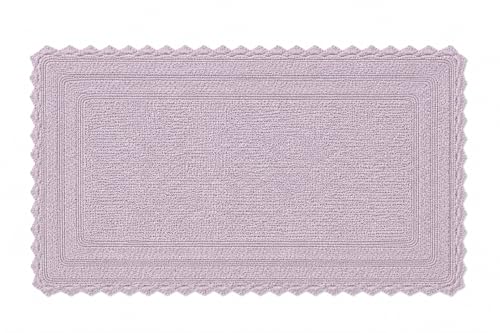
IMPORTANT PLEASE READ BEFORE PURCHASE: Please review all product images for size, color tone, and wash care instructions before ordering. Use gentle cycle with cold water in a front-load or agitator-free washer only. Do not use top-load washers with center agitator, as rough washing may damage cotton fibers and crochet edges. Please verify dimensions carefully, as bath rugs are commonly returned due to size selection. Colors may vary slightly across screens.
Hand-Knotted, Hand-Tufted, or Flat-Weave

Hand-knotted rugs are the ones built to outlive you. A single piece takes months or years to finish, with each knot tied by hand around warp threads so the pattern becomes the structure itself. That density is why museums like The Metropolitan Museum of Art still display centuries-old examples that hold their shape and color.
Hand-tufted rugs sit in a different category entirely. A craftsperson uses a handheld drill gun to punch loops of yarn through a cloth backing, then glues on a second fabric layer to hold everything in place. The work still demands skill and time, but the latex adhesive breaks down over years, not generations. These are shorter-term investments, fine for a room refresh you plan to redo in five or ten years.
Flat-weaves such as kilim, dhurrie, and soumak skip the pile completely. The pattern is woven directly into the foundation, giving you a thin, reversible rug that wears hard but wears even. Quality flat-weaves command serious prices, especially from Turkey, India, or Mexico, yet they still differ from knotting in what they can take. No pile means no cushion underfoot and no hiding place for dirt, but also no glue to fail and no shedding to manage.
The construction method tells you the lifespan before you ever ask the price. Knotting for permanence, tufting for flexibility, flat-weave for high-traffic floors where you want something you can shake out and flip.
Recommended Products

Handwoven 100% Cotton Chindi Rug – Expertly handcrafted from premium cotton fabric strips, this woven rag rug features a timeless black, ivory, and gray striped design that adds warmth and texture to farmhouse, boho, rustic, and modern home décor.

Designed to withstand everyday wear, this 4' x 6' area rug is the perfect size for kitchens, entryways, living rooms, or anywhere you want to add a touch of natural texture and warmth.

Each Cotton Rugs measures 24 inch by 36 inch ,Handcrafted Cotton Woven Rugs.
How Long Each Kind Actually Lasts

A handmade rug that sees normal traffic in a living room or bedroom will usually outlast two or three machine-made replacements. Handmade rugs last 20 years to over a century; machine-made ones tend to give out between 5 and 20 years, even with decent care. The gap comes down to what is holding the fibers together. Hand-knotted wool is locked in place by thousands of individual knots; the backing on a synthetic rug is essentially glued, and that adhesive breaks down with vacuuming, sun, and foot traffic. An 8′ x 10′ hand-knotted rug takes 7 to 15 months to make, so the labor cost is front-loaded into the price, but the per-year cost often ends up lower.
For buying used, this math matters. A fifty-year-old hand-knotted rug with worn pile can still be worth restoring; a fifteen-year-old machine-made rug with frayed edges is usually landfill. Check the back before you pay estate-sale prices.
Recommended Products

100% Cotton, made in India

🧵 Artisan-Crafted Excellence – Made by skilled artisans, this hand-braided jute rug from HandloomBazzar showcases authentic craftsmanship and timeless natural charm.
Luxurious Craftsmanship: Expertly hand-knotted by skilled artisans, each Luxe Loom rug epitomizes timeless elegance and quality craftsmanship
What the Price Gap Really Means

A hand-knotted rug can take months or years to finish, and that timeline is baked into the price. Every knot is tied by hand, every batch of dye is mixed and watched, and the slight color shifts called abrash come from the human eye, not a programmed setting. Factories can copy the pattern, but they cannot replicate the hours.
A good handmade rug doesn’t just wear out — it actually gets better with age. It softens, it ages, and it usually looks even more beautiful as the years go by.
That aging matters if you plan to keep the rug for a decade. If you refresh your living room every two years, a machine-made rug in synthetic fiber is often the smarter buy. It costs less, it holds up under a vacuum and a steam cleaner, and when the style shifts, you are not sitting on an investment you feel guilty about replacing. The premium pays off when you want the rug to outlast the trend.
Frequently Asked Questions
How do I know if a rug is handmade or machine-made?
Flip the rug over and look at the back. A handmade rug shows thousands of slightly uneven knots in a clear pattern that bleeds through, while a machine-made rug has a uniform grid or stiff glued backing with no individual knots. The fringe on a handmade piece is part of the foundation itself, not sewn or glued on afterward. A handmade rug also bends and drapes easily; a machine-made one often resists folding and can crack.
What does abrash mean in a rug?
Abrash is the soft banding or streaking of color across a handmade rug caused by hand-dyeing wool in small batches. Each batch takes dye slightly differently, so the tone drifts as the weaver works row by row. Collectors actively seek out abrash because it adds depth and dimension no machine can copy. Uniform color from edge to edge is usually the mark of factory production.
Are handmade rugs worth all the money?
Handmade rugs last 20 years to over a century, while machine-made ones typically give out in 5 to 20 years, so the higher upfront cost often yields lower per-year expense. A handmade rug can be restored after decades of wear; a worn synthetic rug usually heads to the landfill. The premium pays off when you want the rug to outlast trends rather than follow them.
Leave a Reply