
Oriental rug pattern types are the regional and tribal designs that distinguish hand-woven rugs from Iran, Turkey, Afghanistan, and across Asia. The catch is that the same search term covers both $300 Baluchi entrance mats and $10,000 Agra palace pieces, so knowing which pattern signals which construction saves you from paying workshop prices for village weave quality. A genuine Kashan medallion runs past 800 kpsi; a Heriz from the same country trades that fineness for wool dense enough that local weavers still credit Mount Sabalan’s copper runoff.
Persian Rug Patterns

Persian rugs carry some of the most recognizable patterns in the oriental rug pattern types you’ll come across, and the differences between city workshop pieces and village weaves are worth spotting before you buy. City rugs from places like Kashan and Tabriz run to intricate floral work with high knot counts, sometimes over 800 kpsi, which lets weavers pack in fine detail the way a higher-resolution screen holds more image. That density takes more time and skill, so it functions as a practical quality signal you can check rather than take on trust.
Tabriz pieces mix floral and geometric patterns and use Turkish knots, while Kashan rugs center on a medallion-and-corner layout in deep blues, reds, and ivory with those same high knot counts. Heriz rugs, also Turkish-knotted, trade fineness for toughness: dense geometric motifs, usually with a central medallion, built from wool that local lore credits to copper deposits in Mount Sabalan runoff. They’re easier to find in oversizes because 19th-century export firms scaled production for Western floors rather than mosque prayer spaces. Serapi is simply a lighter, airier branch of the same Heriz family.
At the other end, Gabbeh rugs ignore all this refinement. Antique ones carry a very high pile and simple geometry, which reads almost modern despite a century of age. For a weekend restyle with a few hundred dollars, that contrast is useful: the same room can take either the formality of a Kashan medallion or the plain utility of a Gabbeh, and the rug does most of the deciding for you.
Recommended Products

Exquisite Design: This dark blue rug features a medallion at its center, adorned with symmetric sprawling floral vines.A dark blue background accented light blue, mint green, and orange.The carpet merges elegant persian motifs and romantic British crafts style. Its rich yet soft tones are both easy to coordinate and add a vintage feel

Pet-friendly and slip-resistant surface: This area rug has a simple color and a luxurious feel. By using our pet-friendly and easy-to-clean carpet, you can enjoy a better time at home. This design adds a soft and luxurious element to your home, and is very suitable for use as a bedroom carpet, perfectly matching family life.
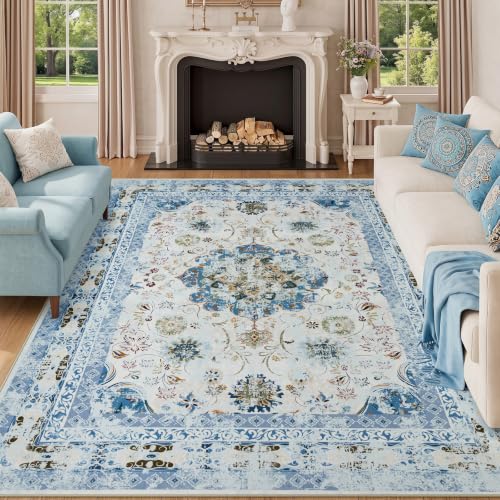
Easy Maintenance: This 5×7 area rug makes cleaning simple and convenient. Regular vacuuming and spot cleaning help keep it looking fresh and vibrant. The low-pile construction is compatible with robotic vacuums for effortless daily maintenance. For best results, avoid using bleach
Turkish and Oushak Rugs

Oushak rugs take their name from the city of Uşak in Western Anatolia, a region that has produced rugs since the early Ottoman period. The Turkish, or Ghiordes, knot used in these rugs is symmetrical and double-wrapped, which builds an even, plush pile that feels different underfoot than the denser asymmetrical Persian knot. That construction difference matters in a room where you want the rug to read as relaxed rather than formal.
The geometric stars and medallions typical of traditional Oushak designs sit flatter and more openly than the fine floral detail Persian weavers favor. Where a Persian piece might fight a modern sofa, an Oushak usually cooperates. By the 19th century some weavers had started adding vines and botanical motifs, but the underlying geometry stayed dominant.
I tend to recommend Oushaks for spaces that already have strong lines: rooms with square-arm furniture, visible ceiling beams, or rectangular windows. The rug repeats those shapes instead of introducing curves that compete. For renters working with a landlord’s neutral paint and standard trim, that compatibility is a real advantage; you get pattern and warmth without the visual noise of a more ornate piece.
Recommended Products

Vibrant & Playful Design: Cheerful diamond blocks in confetti-inspired hues pop on a soft cream background, dotted with dainty polka dots. Like confetti bursting from a party box, each diamond invites tiny feet to skip and discover, instantly turning any space into a whimsical playground that sparks creativity and blends with vibrant or neutral decor

Size : 6'7'' X 9'6''; Color: Ivory

Size : 5'3" Round; Color: Light Blue
Afghan Rug Patterns

Afghan rugs carry a visual weight that immediately separates them from the finer, more crowded Persian pieces most people picture first. The geometry is bolder, the color range tighter, and the overall effect reads more tribal than courtly. Where a Persian pattern might spiral inward with floral detail, an Afghan design tends to repeat large hexagons, hooked diamonds, or gul motifs across the field at a scale that holds up even under furniture.
The palette stays disciplined: deep reds, burgundies, and black dominate, with none of the pastel range you sometimes find in Persian work. That limitation is regional, not accidental. The wool comes from local sheep and carries a dense, almost bristly texture that wears hard and looks it. In a room where you want the rug to ground everything else rather than compete, that restraint works in your favor.
Turkmen rugs share some of this DNA, especially the repeated gul and the saturated reds, but Afghan patterns usually run larger in scale and looser in repetition. A Turkmen piece can feel like a tight grid; an Afghan piece leaves more breathing room between motifs, which helps when you are laying it in a smaller space and do not want the pattern to feel like it is vibrating against the walls.
Recommended Products

Handwoven Craftsmanship: Expertly crafted by artisans using traditional kilim weaving that gives every piece a unique handmade charm.

The handmade, hand-tufted Construction adds durability to this rug, ensuring it will be a favorite for many years.

Safavieh's Antiquities Collection evokes the old world style and quality with modern hand tufting techniques. These rugs bring traditional sophistication and the authentic look and feel of 19th century Persian rugs. These rugs are made from 100% premium, hand-spun wool, and employ ancient pot-dying techniques to give them their authentic look. The soft palettes and open fields make these rugs easy to match to any decor. Each rug has a dense, soft pile, and excellent quality, to ensure that you will enjoy the look and feel of your rug for years to come.
Indian and Agra Rug Patterns

Agra rugs carry one of the clearest cases of design migration in the rug world. The Mughals brought Persian weaving techniques and court aesthetics to India in the 16th century, and Agra weavers spent the next few hundred years turning that borrowed vocabulary into something unmistakably their own. Where Persian rugs stayed regimented in their layouts, Agra pieces loosened into spiraling vines, flowers in vases, lattices, and mihrabs that point toward Mecca. The color range widened too: vegetable dyes produced golds, soft reds, and blues that could run almost kaleidoscopic against the soft pastel grounds more typical of the classical pieces.
The price spread is wide, from about $1,000 to $10,000 depending on age and knot density, but the visual signature is consistent. Agra rugs suit grand living rooms or long hallways where the intricate floral work has room to read. Colonial interiors and traditional Indian decors both handle them well; the trick is giving the pattern enough floor space so it does not fight surrounding furniture.
Recommended Products

【Extra Large Size】: The magic constellation area rug is 5'x7' . Strongly bound on all edges for a clean, tidy look and longevity. This soft black white star rug makes the greatly addition to any living space, instantly enhancing the look and feel of your room.

PERFECT FOR HIGH TRAFFIC AREAS: Thanks to its polyester fiber and strong construction, it doesn't shed

【Modern Oushak Collection】: Traditional Oushak patterns in soothing blue evoke old-world charm. The timeless motifs design brings depth and heritage to both classic and contemporary rooms
Chinese Rug Patterns

Chinese rugs stand apart from the geometric and floral traditions that dominate most of the rug world. Where Persian and Turkish weavers built complex repeating borders and medallions, Chinese makers leaned into pictorial scenes and natural motifs drawn from lore and landscape. The result is less a patterned floor covering than a woven painting you walk on.
Silk from silk worms made these representational designs possible, giving the fine thread needed for detailed work. A Chinese rug might show a single mountain scene, birds among bamboo, or a dragon winding through clouds, each element placed as it would appear in nature rather than flattened into repeating geometry. The approach feels closer to Chinese scroll painting than to textile tradition.
This less repetitive style means a Chinese rug reads as a single statement piece. In a bedroom or living room, it can anchor the space the way a large canvas would, though the cost and delicacy of silk pile makes it a judgment call for high-traffic spots. For renters or first-home owners working weekend timelines, the wool versions carry the same scenic sensibility at a sturdier weight.
Recommended Products

Perfect Size – This area rug comes in many sizes 5×8, 9×12, 8×10 and other popular sizes. It is ideal for any room like the Living Room, Bedroom, & Kitchen. Match all sizes from Small Area Rugs to Large Area Rugs in this amazing trellis pattern area rug.

Perfect Size – This area rug comes in many sizes 5×8, 9×12, 8×10 and other popular sizes. It is ideal for any room like the Living Room, Bedroom, & Kitchen. Match all sizes from Small Area Rugs to Large Area Rugs in this amazing trellis pattern area rug.

Modern geometric design: Inspired by Mondrian-style box patterns, this rug features intersecting rectangles in layered tones of blue, ivory, and gray—adding structure and visual balance to any contemporary interior.
Caucasian Rug Patterns

Caucasian rugs sit apart from the Persian tradition most people picture when they hear "oriental rug." Where Persian designs lean curvilinear and courtly, these carry bold geometric patterns and angular motifs that read more like tribal art than palace craft. The color runs hotter too, saturated reds and blues and golds that come from the varied cultures packed into the Caucasus region between the Black and Caspian Seas.
The difference is structural as much as stylistic. Persian rugs often flow with floral vines and medallions; Caucasian weavers built their patterns from straight lines, stepped diamonds, and hooked polygons that repeat across the field. That geometry isn’t decorative preference alone. It reflects the regional and tribal character of weaving villages scattered through mountain valleys, each with recognizable motif sets that signal where a rug was made.
For a renter or first-time owner hunting something with presence but not formality, this is where to look. The angular designs read modern against clean furniture, and the color saturation hides wear better than subtler palettes. Prices stay approachable because these never carried the same court prestige as Persian city rugs, though the durable wool pile and tight weave hold up to the same traffic.
Recommended Products

【Printed Design Area Rug】Printed rugs are a technological innovation to traditional handmade rugs, designed to look handmade, meanwhile cheaper, more durable, and more colorful, non-shedding. The Vintage Collection is traditional and timeless with a beautiful printed lived-in design that will complement your home décor

Machine Washable & Stain Resistant, Easy to Clean: This 8×10 washable area rug resists spills and stains, if a drink is accidentally spilled, it can be cleaned up by simply wiping it immediately with a towel. You can clean it with vacuum or robot cleaner; for localized stains, you can use a cleaning agent and a damp cloth for spot cleaning; and for deeper care, simply machine wash it to keep your area rug looking fresh
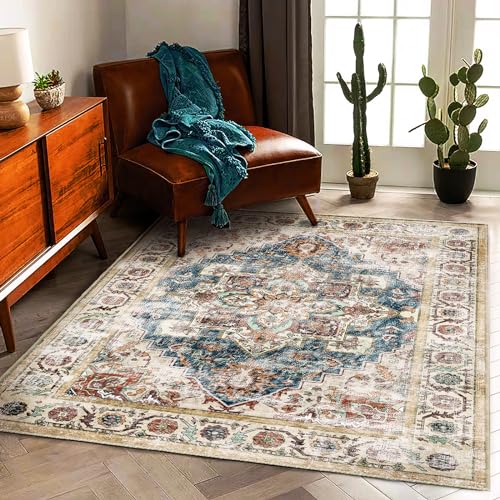
Soft Designed: This CHAMPLANT area rugs has a trendy faded style and a unique floral pattern, vintage tones blend perfectly with your home. This rug is made of high-quality faux wool fibers; Easy on the feet-soft as cotton balls; stain-resistant and non-shedding
Kilim Flat-Weave Patterns

Kilim rugs are flat-woven, not knotted, with the design created by interweaving different colored weft and warp threads. The technique leaves vertical slits at the edges of color changes, which gives the geometric patterns their sharp, almost stained-glass definition. Because there is no pile, the finished rug is lightweight and the visual texture reads completely differently: flat, graphic, and immediate rather than soft and dimensional.
The motifs tend toward bold geometry: animals, plants, and abstracted natural events rendered in vivid color blocks. What makes a Kilim distinct from a piled rug is not just the weave but the weight and the way it sits underfoot. I have rolled one out in a bedroom where a heavy hand-knotted piece would have felt like overkill, and the difference in how the room opened up was noticeable. The tradeoff is the lack of plushness, which matters on bare floors in winter. For a weekend refresh with a few hundred dollars, though, the format works: easy to move, easy to layer, and the patterns carry enough visual noise to anchor a space without demanding new furniture around them.
Recommended Products

Oriental Floral Elegance: Layers of blooming flowers, leafy vines, and graceful birds framed by a vintage scalloped border bring timeless Chinoiserie-inspired beauty into your home. The soft beige base sets a calming mood, blending classic artistry with European romance for a truly decorative centerpiece.


Floral Vintage Charm: Layers of lush botanical florals framed by an ornate border bring timeless American vintage elegance to your home. The soft cream base and warm floral tones create a welcoming mood—like stepping into a sunlit garden filled with stories.
Hand-Knotted vs. Machine-Made Construction

A genuine oriental rug is woven by hand on a loom, with warps, wefts, and pile made mainly of natural fibers like wool, cotton, and silk. The pile threads are knotted into the foundation one by one, a process that stretches over several months rather than the few hours a machine needs. That handwork leaves irregularities in the design, slight shifts in pattern that become your best clue when the back of the rug is visible.
Machine-made rugs usually show a hard plastic backing and colors that may bleed; their fringes are sewn or glued on rather than emerging from the warp threads. Hand-knotted rugs have the same coloration and texture on both sides, with fringes that are integral to the structure. Natural sheep’s wool, sometimes colored with plant dyes, gives the real thing a durability that synthetic fibers rarely match. The tradeoff is price and patience. A hand-knotted piece costs more and takes longer to find, but it survives decades of use. For a renter or a first-home owner doing one refresh a year, the question is whether you need that longevity or just the look for now.
Recommended Products

The handmade, hand-tufted construction adds durability to this rug, ensuring it will be a favorite for many years.

[DESIGN & PILE]: SAFAVIEH's Heritage rug centers a traditional medallion in multi on burgundy, and its 5/8" pile is dense and even underfoot in a living room, dining room or bedroom.

[DESIGN & PILE]: SAFAVIEH's Abstract rug holds a solid natural field inside an ivory border, and its soft 1/2" pile is dense and even underfoot in a living room, bedroom or dining room.
Wool, Silk, and Cotton Materials

Wool, silk, and cotton each carry a pattern differently, and the difference matters the moment you unroll one in your living room. Wool pile on a cotton foundation is the standard pairing: cotton warps and wefts take tension without buckling, so larger rugs lie flat where wool foundations might shrink unevenly and ripple at the edges. The wool surface holds dye from plants and minerals with a depth that synthetics never quite match, and the slight irregularity of hand-spun fiber gives patterns a living quality that machine precision flattens.
Silk changes the equation entirely. Representational rugs, the kind with fine floral or figurative work, rely on silk’s sheen and the tighter knotting it allows; the pattern reads with photographic clarity that wool’s texture softens. The tradeoff is placement. Silk survives best in low-traffic, low-sun spaces where the investment isn’t ground down by daily use.
Cotton appears in the pile itself on some traditional pieces, though more often it stays hidden in the structure. Nomadic weavers who couldn’t source cotton used wool throughout, and those all-wool rugs carry a different character: slightly softer edges to the pattern, more give underfoot, and a tendency to settle into uneven floors rather than bridge them.
Natural dyes are what separate the colors you live with from the colors that merely fill space. Madder root, indigo, cochineal, the mineral blacks; each bonds to protein fiber at a molecular level, so the color seems to rise from within the wool rather than sitting on top. Over years the tones mellow rather than fade, which is why a twenty-year-old vegetable-dyed red looks borrowed from something older, while synthetic reds flatten to a single note. The material and the dye are inseparable decisions: silk demands the finest dyework to justify its cost, wool forgives a slightly muddier palette, and cotton in the foundation never shows the choice at all.
Recommended Products

ICONIC DESIGNS: Discover iconic designs that capture the essence of fame and glamour. adding a touch of celebrity-inspired luxury to your interior design.

ICONIC DESIGNS: Discover iconic designs that capture the essence of fame and glamour. adding a touch of celebrity-inspired luxury to your interior design.
ICONIC DESIGNS: Discover iconic designs that capture the essence of fame and glamour. adding a touch of celebrity-inspired luxury to your interior design.
Regional and Tribal Origins

The oldest known carpet still in existence is a Persian rug dating back to the 5th century BC, and Greek texts from that same era already treated these pieces as luxury goods. That timeline matters because the patterns you see today grew out of specific valleys and tribal migrations, not from a single national style. Greater Persia once stretched across the Caucasus, West Asia, Central Asia, and South Asia, and the mountains and deserts between those regions kept weaving traditions isolated enough that historians can still pinpoint where an antique rug was made by reading its symbols.
Broadly, Persian rugs split into two camps. City rugs come from organized workshops where weavers follow paper blueprints, usually on cotton or silk foundations. Tribal or nomadic rugs are woven in homes or tents on wool foundations, and the designer and weaver are the same person working from memory. The result is looser, more fluid, and equally collectible.
Some of the most distinctive regional pieces come from names that rarely surface in beginner guides. Baluchi rugs, woven by tribes across the border region of Afghanistan, Iran, and Pakistan, run small and tight with fine wool in deep blues, reds, and browns. Their detailed geometric designs hold up well in high-traffic spots like entrances or bedside accents, and they typically range from $300 to $3,000 depending on age and complexity. Zanjan rugs from northwest Iran carry the influence of neighboring Bijar and Hamadan: single-wefted wool or cotton foundations, both Turkish and Persian knots, central medallions with star motifs and paisley, and a palette that alternates reds and dark blues with ivory, gray, green, and camel. These are generally more affordable than other Persian city rugs, which makes the rarity sting a little less when you find one.
Recommended Products

Designed to withstand everyday wear, this 5' x 8' area rug is the perfect size for bedrooms, dining rooms, living rooms, or anywhere you want to bring a little more style into your home.

Modern Area Rug: This area rug is designed with a Bohemian and Moroccan style pattern using a combination of geometric lines and shapes, able to integrate into any interior design style easily, it can add elegance and fashion to your home space.

Perfect Size – This area rug comes in many sizes 5×8, 9×12, 8×10 and other popular sizes. It is ideal for any room like the Living Room, Bedroom, & Kitchen. Match all sizes from Small Area Rugs to Large Area Rugs in this amazing trellis pattern area rug.
Care and Storage

Regular vacuuming on a light setting keeps natural fibers from grinding dirt into the pile, but a deeper clean belongs to a professional who knows how antique dyes react. I roll mine from the bottom with the pile facing inward before any long-term storage; silk is the exception, since rolling it pile-out places less strain on the foundation. Folding is the mistake that cracks a rug over time, and I check stored pieces often enough to catch the three problems that actually show up: insects, flooding, and mildew. Sunlight deserves more attention than most people give it. Chemical washing and extreme fading are often irreversible, so I rotate my rugs to even out the wear rather than letting one corner take all the light. Humidity matters especially with silk, which can turn brittle and split if it gets wet and dries wrong. A well-cared-for antique outlasts a lesser modern rug by years, but only if the care starts before the damage does.
Frequently Asked Questions
What are the different types of Persian rugs?
Persian rugs split into city workshop pieces and village or nomadic weaves. City rugs from Kashan and Tabriz carry intricate floral work with knot counts sometimes over 800 kpsi, while village pieces like Heriz trade fineness for toughness with dense geometric motifs. Tribal rugs including Gabbeh, Baluchi, and Qashqai are woven from memory rather than blueprints, giving them a looser, more fluid character.
How can I identify a genuine hand-knotted oriental rug?
Flip the rug over and look for slight irregularities in the pattern, which are the natural result of months of individual knotting. Genuine pieces show the same coloration and texture on both sides, with fringes that emerge from the warp threads rather than being sewn or glued on. Machine-made rugs usually have a hard plastic backing and colors that may bleed.
What is the difference between antique and vintage rugs?
Antique rugs are typically over 100 years old, while vintage rugs fall between 30 and 50 years old. The gap matters for construction as well as age: antique weavers worked from memory with hand-spun wool and vegetable dyes, whereas vintage pieces may already reflect shifted techniques and materials.
Leave a Reply